Airflow 3 + BigQuery Data Layer for a Property-Tech AI Tool
The data foundation for an AI tool that finds energy waste in buildings: self-hosted Airflow 3, a 65-way mapped backfill into BigQuery, idempotent MERGE loads, partition-pruned cost, and a CI gate so no DAG ever reaches the scheduler by hand.
- Role:
- Sole engineer: architecture, pipelines, warehouse design, CI/CD
- Period:
- September 2026, client project (data-integration phase)
- Apache Airflow 3.3
- BigQuery
- Python 3.12
- Docker Compose
- GitHub Actions
- SMHI open data
- pytest
The brief
A Swedish property-tech company is building an AI tool for real-estate owners. The idea is simple to say and hard to do: pull in every signal a building produces (sensor readings from the building management system, energy meters, tenant complaints, weather), put it in one place, and let a set of rules point at the "energy thieves": the ventilation that runs all weekend, the heating and cooling fighting each other in mild weather.
None of the rules work without the data layer underneath them. That layer was my job: reliable pipelines, a warehouse that stays cheap as it grows, quality checks that go red before an analyst trusts a bad number, and a deploy path that doesn't depend on anyone remembering to click "upload".
Decisions before the first line of code
Self-hosted Airflow, not a managed one. Cloud Composer starts around $300 a month sitting idle. For a pilot on two buildings that's the wrong shape of bill. Airflow 3.3 in Docker Compose with the LocalExecutor runs on a laptop today and on a small VM tomorrow, and I own every failure, which, it turned out, was the useful part.
Logic in a plain Python package, DAGs as thin wiring. Everything that parses, validates or loads lives in src/eugenia/ and imports nothing from Airflow, so it has fast unit tests that run anywhere. The DAG files only say what runs after what. Airflow doesn't run natively on Windows, and this split meant the day-to-day test loop never needed Docker.
Git is the only way in. A pull request runs lint, the unit tests, and a DAG-integrity test that imports every DAG file and fails on any import error, missing owner, or missing retry. A merge to develop copies the DAG folder to the host and asks the Airflow there the same question; if it prints an import error, the deploy is red. There is no upload path.
The backfill: 45,000 rows without one giant task
The first real job was a year of hourly weather for two stations and three measurements: about 45,000 rows. One task doing all of it is fragile: die at row 40,000 and you start over. One task per row is 45,000 tasks, and Airflow refuses to map more than 1,024.
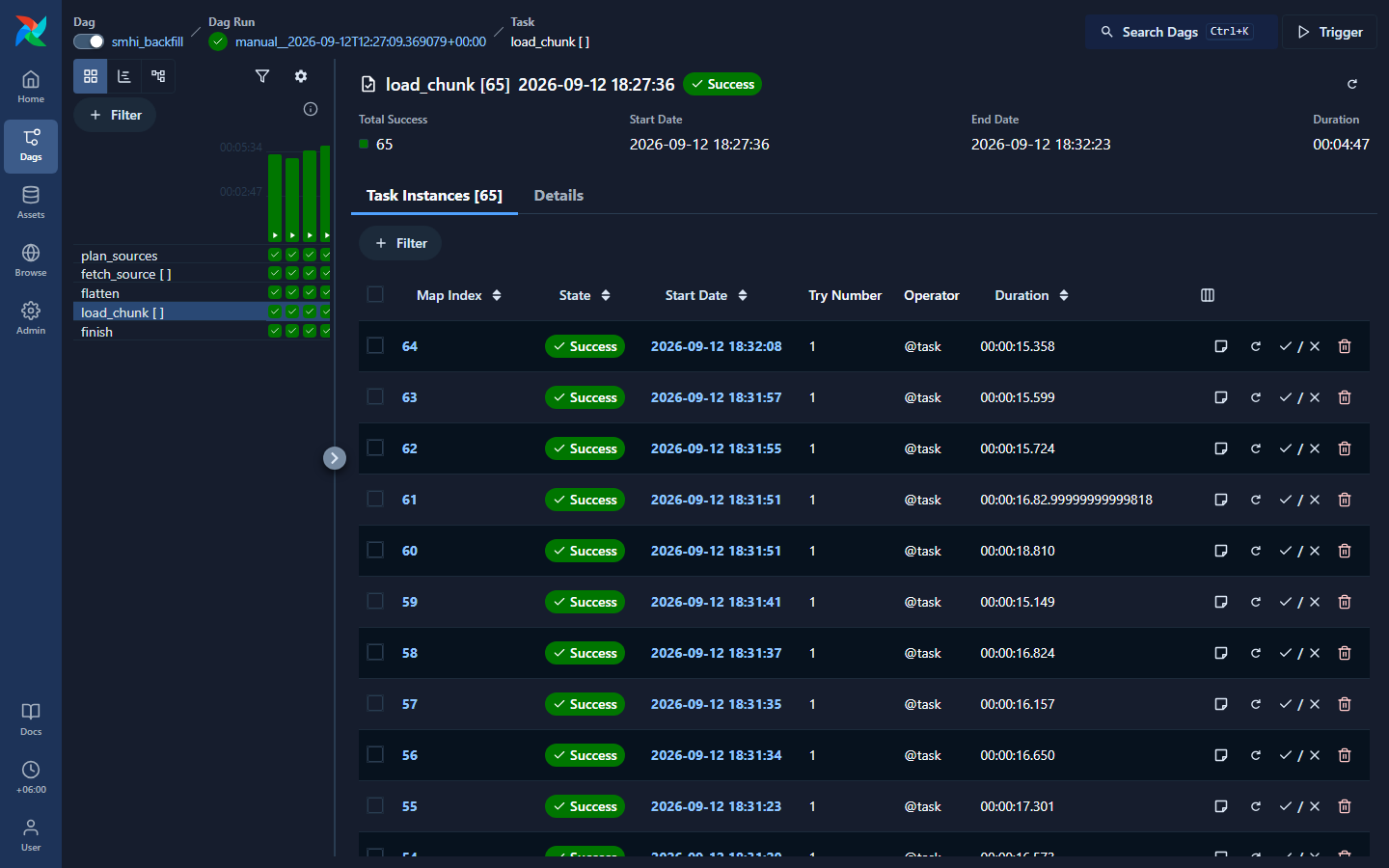
So the planner cuts the year into one file per station, per measurement, per month. That comes out to 65 files of roughly 700 rows each (13 months, because the current month is partial; Stockholm's wind series has no data this year, so its files are never written). A single load_chunk task is written once and Airflow makes 65 copies of it at run time. A unit test on the planner asserts the count can never quietly grow past the limit.
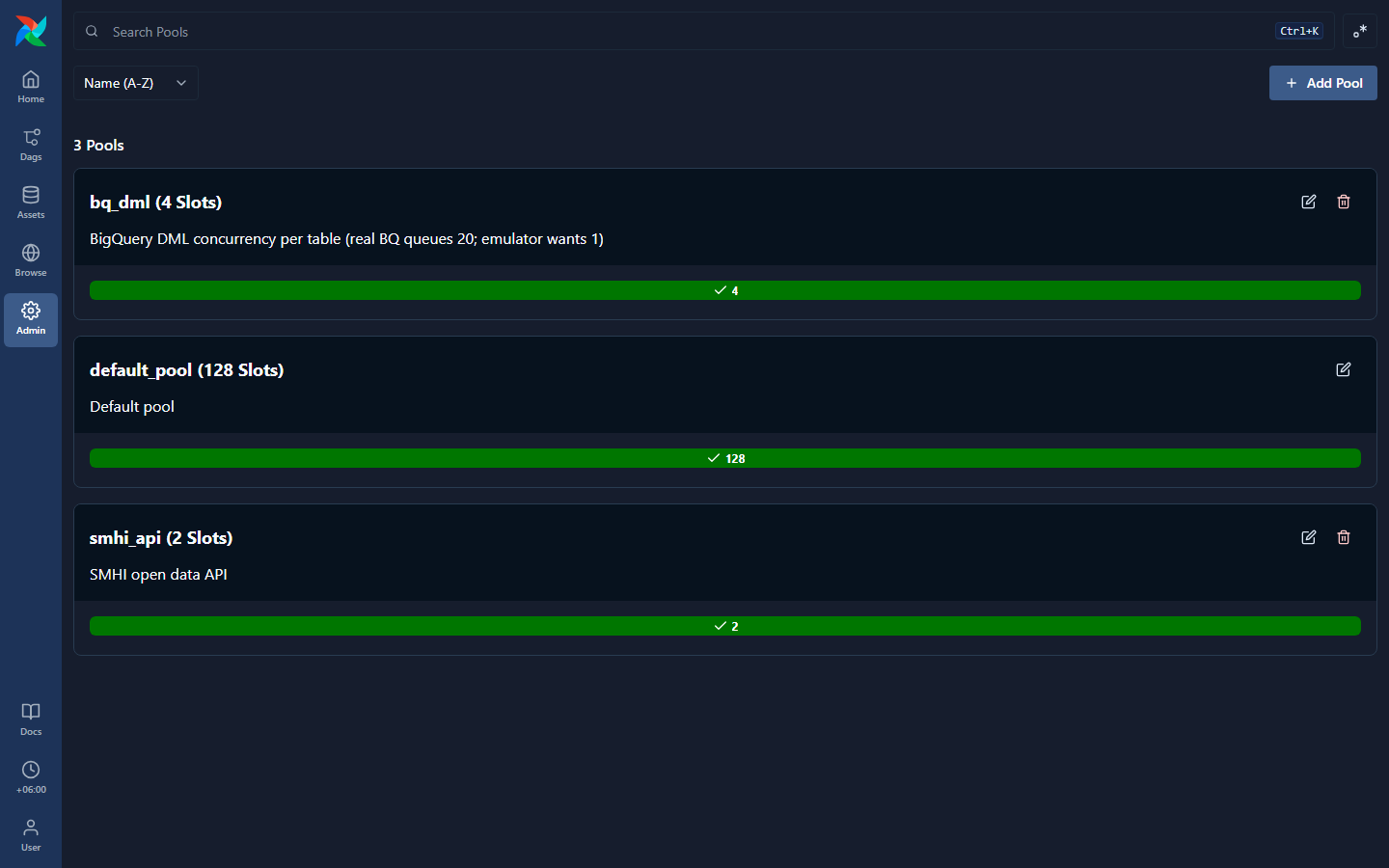
Two pools keep it polite. The SMHI fetches get two slots so I'm not hammering a public API; the BigQuery loads get four, because BigQuery queues DML statements per table and more parallelism just makes them wait in a different queue. Retries are three with exponential backoff from 30 seconds up to 10 minutes.
Loading so that a retry can never duplicate a row
Every chunk goes into a temporary staging table first, through a load job: free, and no streaming buffer. Then one MERGE copies it into the real table, matching on station, measurement and timestamp: update if the row exists, insert if it doesn't. Run the same chunk twice and you still get each row once. The staging table is dropped either way.
I chose load jobs over streaming inserts for three reasons that turned out to matter: streaming is refused in the BigQuery sandbox, it's billable everywhere else, and streamed rows sit in a buffer where DELETE and UPDATE are refused for up to 90 minutes, exactly the operations an idempotent load needs.
The proof is boring, which is the point: I ran the full backfill, counted 45,113 rows, ran it again, and counted 45,113 rows.
The failure I'd tell in an interview
The very first backfill: I'd just triggered it and was watching the grid. Five of the six fetch tasks went green. One went yellow and started retrying.
The log said 404 Not Found from SMHI, for wind speed at the Stockholm station. The same call worked for Gothenburg. I went to SMHI's catalogue and found the answer: that station simply doesn't publish wind for recent months, only the historical archive. The 404 was correct. My client didn't know the difference between "the server is unhappy" and "this thing doesn't exist", so Airflow retried it three times with backoff (four attempts over five minutes) and then failed the whole series, including the archive half that had worked.
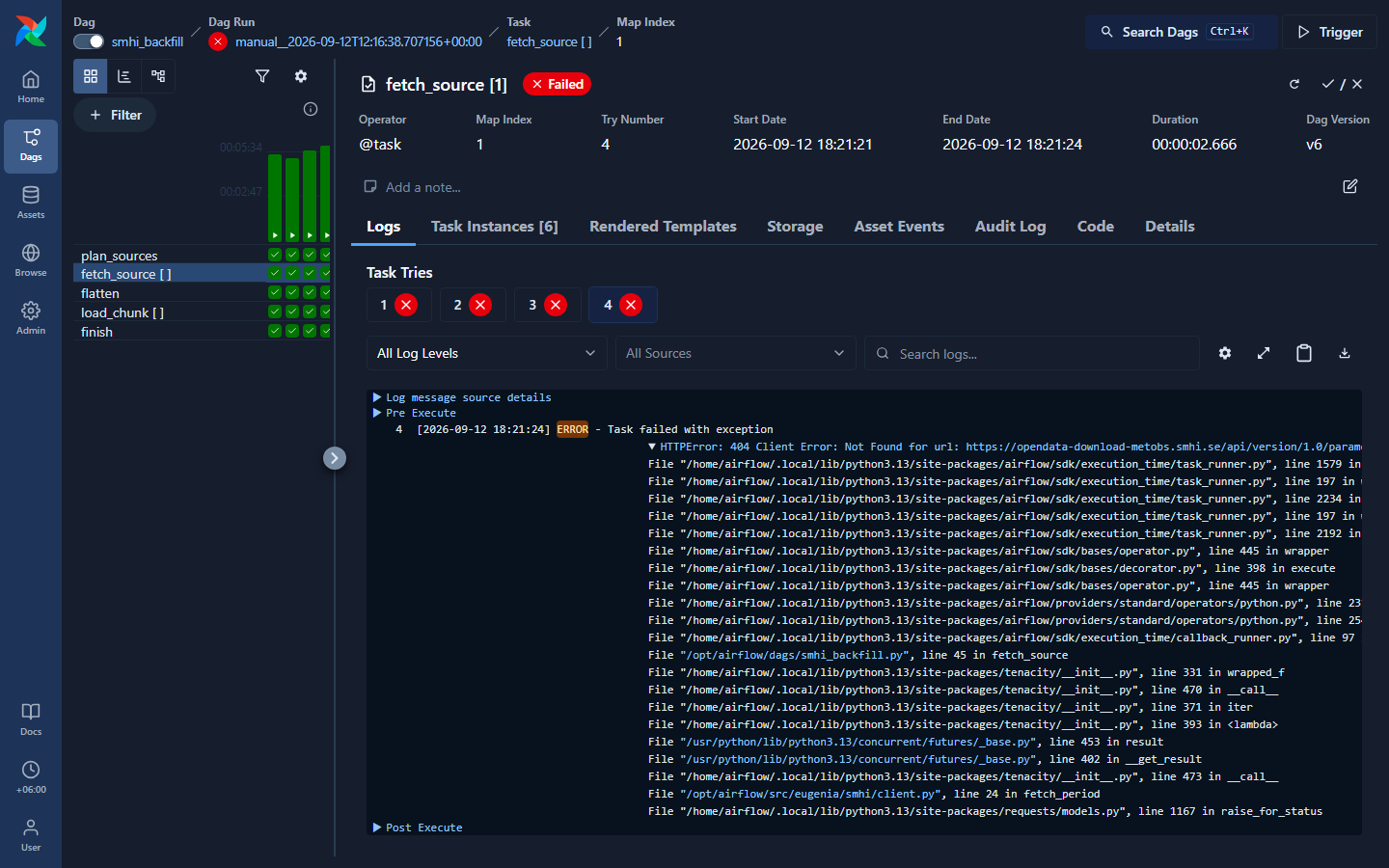
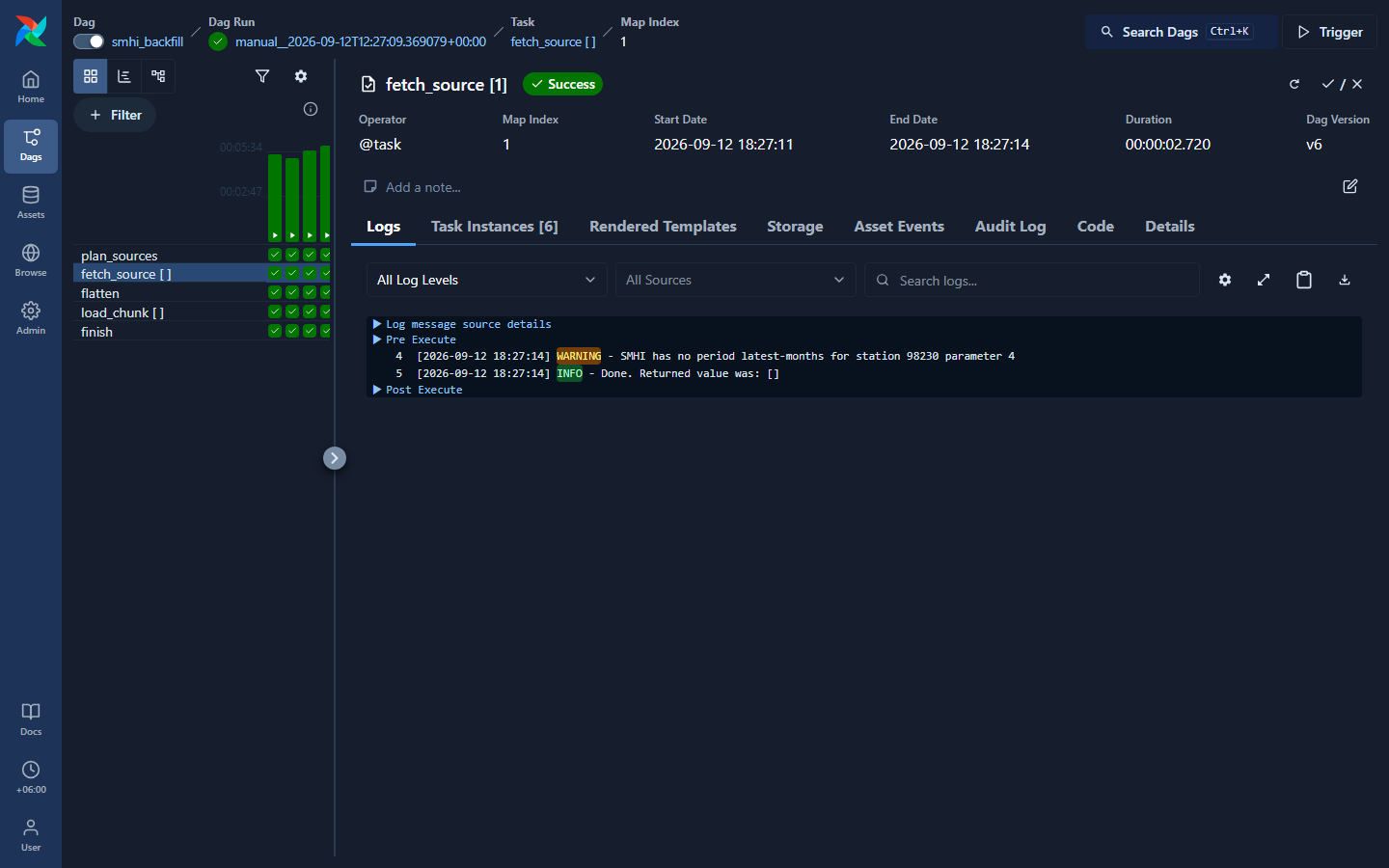
The fix that stuck is small. A 404 on a period now returns empty, logs one warning line, and is never retried. A unit test counts the HTTP calls, so if anyone puts the retry back by mistake, the test fails and tells them.
Keeping the bill flat as the table grows
BigQuery charges by bytes scanned. A MERGE against an unpartitioned table reads the whole table every time, so the cost of loading one month grows with every month already loaded. On 45,000 rows that was 1.9 MB per chunk: nothing today, a real line item at ten years of data.
The tables are now partitioned by day and clustered by station and measurement, and every MERGE carries a predicate that bounds it to the chunk's own dates. BigQuery reads only the partitions the batch touches. Measured on the full table: 1,924,776 bytes down to 145,302 per chunk, about 13× less, and it stays flat instead of growing. The whole 12-month backfill scans 9 MB against a 1 TB monthly free tier.
There was a second, quieter lesson in that change. Datasets created while a project is still in the BigQuery sandbox carry a 60-day default expiry that survives enabling billing. When I recreated the table as partitioned, it inherited that, and BigQuery silently dropped every partition older than 60 days: 45,113 rows merged, 7,255 left, every task green. A row count after the load is what caught it. ensure_tables now clears the expiry on every dataset and table, every run.
The rest of the pipeline
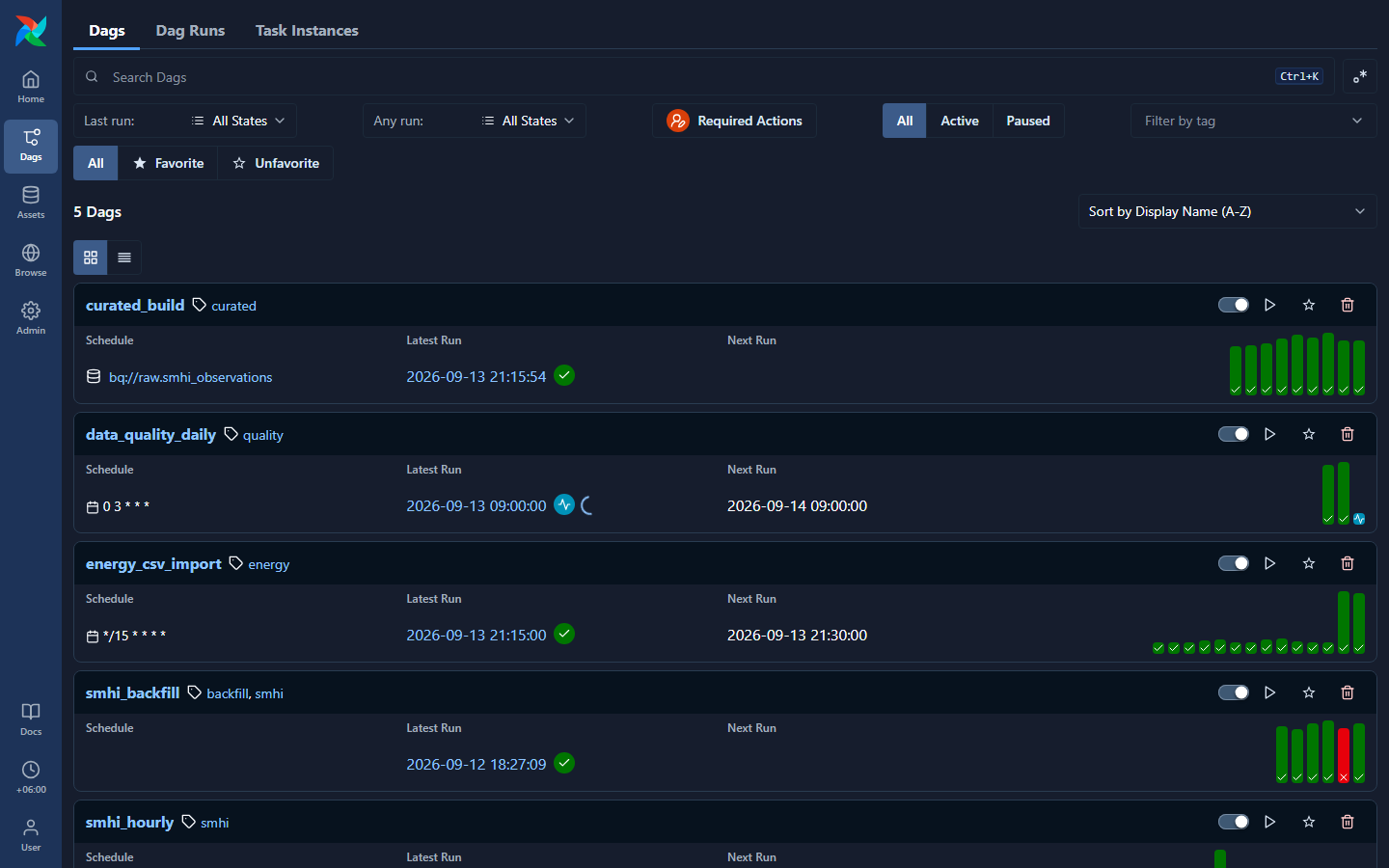
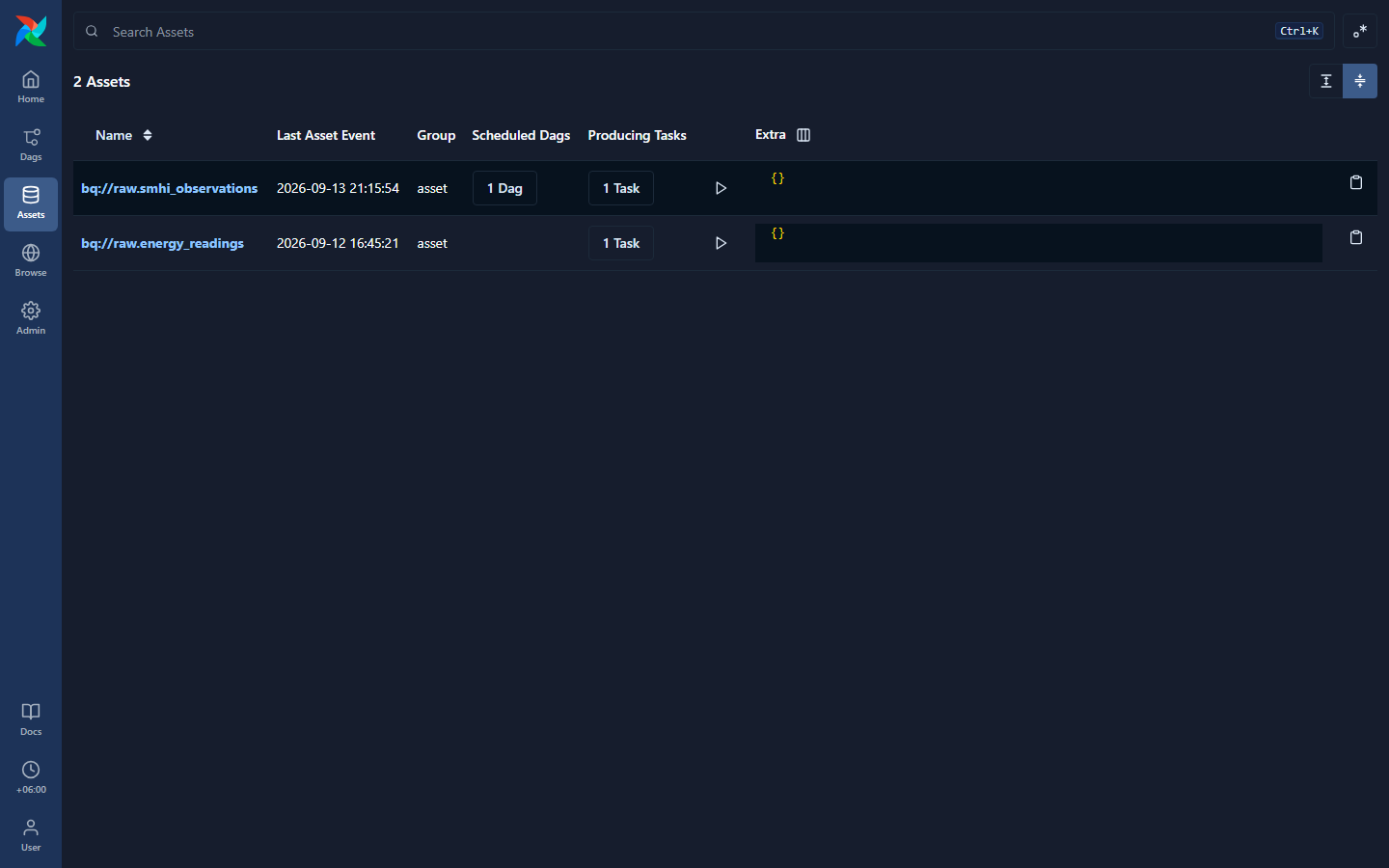
smhi_hourlypulls the latest hour for every series and merges it through the same loader. When it finishes, it announces an Asset.curated_buildhas no schedule; it starts when that Asset changes and rebuilds the hourly weather table per property, with the degree-day contribution the energy rules consume. I build the table; the analysts own the rules on top of it.energy_csv_importwatches a drop folder every 15 minutes, validates each file as a whole (columns, meter types, units, timestamps, MWh normalised to kWh), loads the good ones, and moves bad ones torejected/with a machine-readable error report. A template violation fails once, without retrying; a retry can't fix a bad file.data_quality_dailyscores every source and property for yesterday: missing hours, out-of-range values, staleness against the series' newest row. Any score under 70 turns the run red so someone looks.
Every run, of every DAG, writes one line to ops.connector_status (rows loaded, errors, outcome), which is what the client's "connector status" dashboard will read.
Results
- 12-month backfill: 65 mapped loads, 45,113 rows, 5 min 14 s, zero retries after the 404 fix; re-run leaves the count unchanged.
- Bytes scanned per chunk MERGE: 1.9 MB → 145 KB, flat with table size.
- 22 unit tests, 4 DAG-integrity tests, 2 integration tests, all green on every PR and on
develop. - Six real failures met and fixed in the first week, each with a test or a guard so it can't come back: the 404 retry, parallel MERGE thrash, a duplicate DAG id from one DAG file importing another, sandbox limits on streaming and DML, a staleness false positive, and the 60-day expiry.
What I'd do differently
Put the row-count-after-load check in from the first commit, not after the expiry incident. Every green run should have to prove what it loaded; a status row that says "success" is not the same as the table saying 45,113.